PREGNANCY
Can I Paint a Room While Pregnant?
There’s more to consider than just the color!

Written by
Happiest Baby Staff
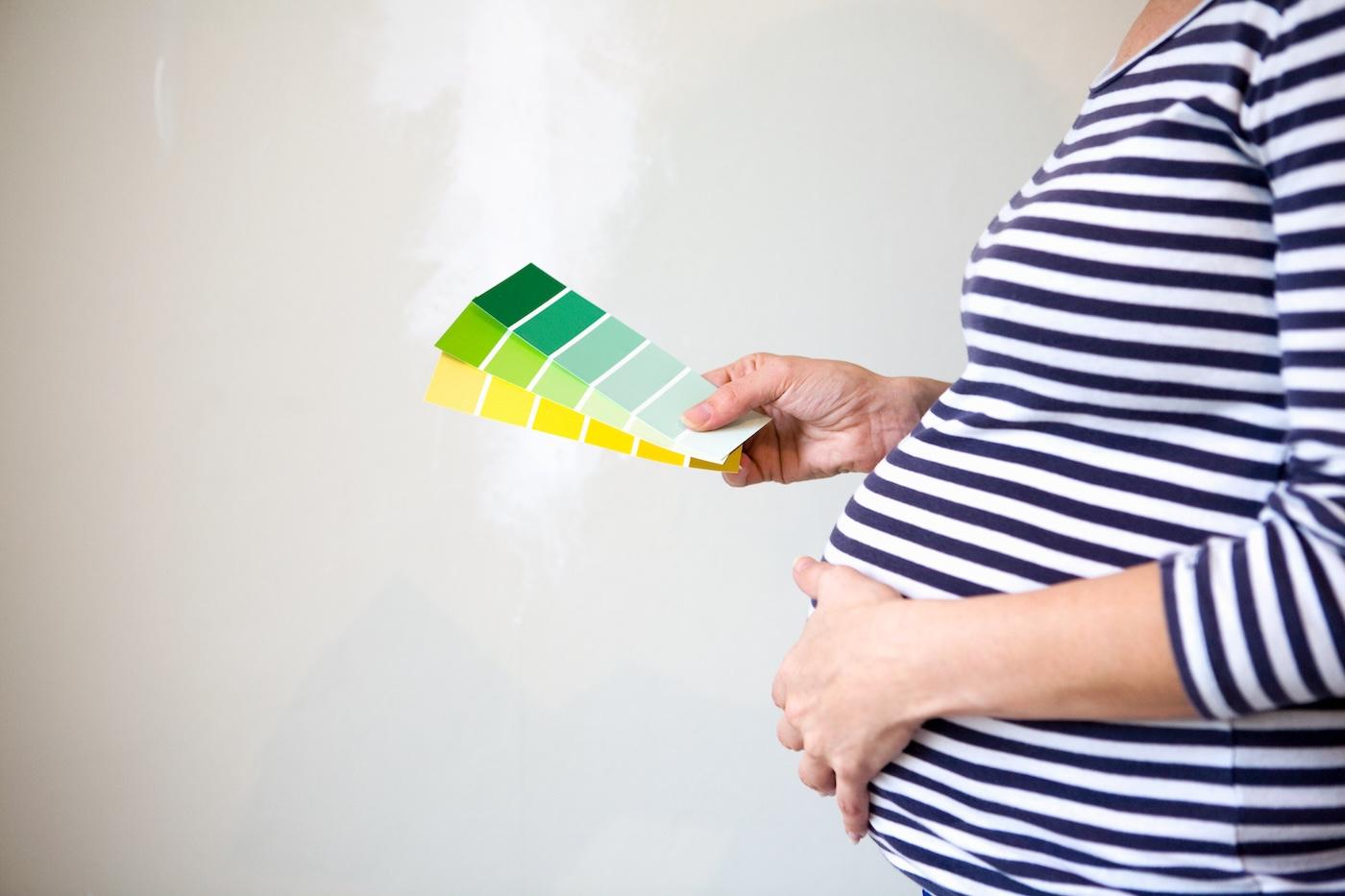
The short answer: Most likely, yes—with precautions. Household painting done carefully is expected to result in low exposure and isn't likely to raise the chance of miscarriage or birth defects. Research is limited, though, so it pays to play it safe: Choose water-based paint, keep the room well-ventilated, protect your skin, and skip the ladder. The bigger, clearer danger is old paint. If your home was built before 1978, don't sand, scrape, or strip painted surfaces yourself—they may contain lead.
Somewhere around the second trimester, it often hits: the overwhelming urge to get the nursery ready. (Yep, nesting is real!) And for many expecting parents, that means rolling a fresh coat of color onto the walls. But between the strong smell and all those warning labels on the can, it's natural to pause and wonder: Is it safe to paint while pregnant? Here's what the science says—plus how to tackle your project in the safest way possible.
Is it safe to paint a room while pregnant?
For most people, occasional DIY painting with modern household paint is considered low-risk. Teratology experts at MotherToBaby—a service of the Organization of Teratology Information Specialists that specializes in exposures during pregnancy—say that household painting with proper safety precautions is expected to lead to a low level of exposure, and it isn't likely to increase the chance of miscarriage or birth defects.
That said, "low-risk" isn't the same as "zero risk. It's not known whether paint exposure can increase the chance of birth defects or other pregnancy complications, like preterm birth or low birth weight. One reason it's hard to study: The actual amount of paint chemicals a person absorbs is usually unknown. And, interestingly, how strongly a room smells isn't a reliable measure of how much you're being exposed to.
What experts are clear on: The type of paint, the amount of fresh air, the length of time you spend painting, and the age of your home all change the calculus. A one-time weekend project in a well-ventilated room is a very different exposure than daily work with solvent-based products.
What does the research say about paint fumes during pregnancy?
There isn't a ton of research on household painting during pregnancy, but a couple of large studies offer some insight.
A Danish study of nearly 20,000 pregnancies looked at people whose homes were painted during the first trimester. Overall, the researchers found no increase in birth defects among babies exposed to paint fumes. When they broke the results into smaller subgroups, they saw a possible link with some specific types of birth defects (involving the kidneys, nervous system, and face and neck), but only the kidney finding was statistically significant, the number of affected babies was very small, and the authors stressed that their findings need to be confirmed.
Then, in 2019 a Japanese study of more than 67,000 births examined home renovation and interior finishing during pregnancy. Those researchers found no significant link between renovation and most birth defects, including heart defects and cleft lip or palate, but did see a possible association with certain genital differences in baby boys. Again, the authors called for more research to confirm the finding.
What about people who paint for a living? Studies of professional painters have had mixed results, with no consistent pattern of birth defects or pregnancy complications. The clearest evidence of harm comes from older reports of people who deliberately inhaled ("huffed") paint or thinner containing toluene during pregnancy—an exposure that’s far higher than anything you'd encounter painting a room at home.
What are the risks of painting while pregnant?
When it comes to painting while pregnant, the fumes from a fresh can of latex paint are rarely the biggest concern. Here are the risks experts flag most.
Lead Paint in Older Homes
Lead is genuinely dangerous during pregnancy because it can pass from parent to baby. Lead in the blood during pregnancy can increase the risk of miscarriage, cause a baby to be born too early or too small, harm a baby's brain, kidneys, and nervous system, and lead to learning or behavior problems later on. And there's a twist: Lead stored in your bones from past exposures can be released into your bloodstream during pregnancy.
The federal government banned lead-based paint in homes in 1978, but plenty of older homes still have it. In fact, the EPA estimates that 87% of homes built before 1940 likely contain lead-based paint—along with 69% of homes built between 1940 and 1959 and 24% of those built between 1960 and 1977.
Here's the key: Intact lead paint that's in good shape usually isn't a problem. The danger comes when it's disturbed. The EPA warns that renovation or repair work that disturbs painted surfaces in older homes can create large amounts of lead dust, and the CDC notes that this dust is so fine you can't see it, so you can breathe it in without realizing it.
If you live in a home built before 1978, the CDC recommends:
- Having your home checked by a licensed lead inspector.
- Leaving the house while someone is removing lead paint, cleaning up after lead paint removal, or remodeling a room that might have lead paint.
And never try to remove lead paint yourself. The EPA advises hiring a lead-safe certified contractor for projects in older homes.
Solvent-Based Paints, Strippers, and VOCs
Paints, varnishes, and paint strippers contain organic solvents that release gases called volatile organic compounds (VOCs) into the air. Short-term VOC exposure can cause eye, nose, and throat irritation, headaches, nausea, and dizziness. And VOC levels can spike dramatically during certain tasks: During paint stripping and for several hours afterward, indoor levels can reach 1,000 times background outdoor levels.
Oil-based (alkyd) paints, which are thinned and cleaned with paint thinner, turpentine, or mineral spirits, generally involve more solvents than latex paints, which clean up with soap and water. Paint strippers deserve extra caution: Some contain methylene chloride, a chemical the EPA notes is known to cause cancer in animals and is converted to carbon monoxide in the body.
Falls From Ladders and Step Stools
This one's easy to overlook! As your belly grows, the extra weight in front shifts your center of gravity, which makes you less stable and more likely to lose your balance and fall, according to the American College of Obstetricians and Gynecologists (ACOG). Balancing on a ladder while reaching overhead with a roller is exactly the kind of activity worth handing off.
Is it safe to paint during the first trimester?
There's no official rule that says painting is off-limits during any particular trimester. But many pregnant people choose to be extra cautious early on since most birth defects occur in the first three months of pregnancy when a baby's organs are forming. If you'd like to stay on the safest side, consider delegating painting projects during the first trimester. (Bonus: You'll likely be dealing with morning sickness anyway, and paint smells can make queasiness worse). The precautions below apply no matter how far along you are.
What kind of paint is safest during pregnancy?
If you're going to paint, take this into consideration:
- Water-based paints (latex, acrylic, or vinyl) are the best choice. These are the most common household paints and clean up with soap and water rather than chemical solvents.
- Low-VOC or zero-VOC paints are a smart extra step. Since VOCs are what you're breathing in as paint dries, choosing a product designed to release fewer of them is a simple way to cut your exposure.
- Indoor paint for indoor rooms. Pick the right paint for the job—so use paint made for interiors when you're painting inside.
What to skip: oil-based paints, paint strippers, and spray paints. Products containing methylene chloride—including some aerosol spray paints and paint strippers—should only be used outdoors when possible.
How to Paint Safely While Pregnant
If you've decided to pick up a roller, use these tips to minimize your exposure:
- Open up: Paint with windows and doors open, and put a fan in the window to keep fresh air moving.
- Take breaks: Step outside for fresh air regularly, and keep painting sessions short.
- Read the label: Follow all instructions for using, cleaning up, and storing the product—and meet or exceed any safety precautions listed.
- Cover up: Wear long sleeves and gloves to protect your skin.
- Keep food out of the room: Don't eat or drink while painting, and wash your hands well when you're done.
- Stay off the ladder: Leave ceilings, high trim, and awkward corners to someone else.
- Don't disturb old paint: In a home built before 1978, skip any sanding, scraping, or stripping, and don't do prep work on walls that may have lead paint.
- Keep ventilating after you finish: Air out the room for two to three days after painting and limit your time in the space.
- Toss leftovers you won't use: Gases can leak even from closed containers, so buy only what you need and dispose of extras safely.
Of course, the simplest way to reduce your exposure is to let someone else do the painting. Consider it a great excuse to put your partner, a friend, or a willing family member to work while you pick out the art for the walls!
Is it safe to paint the nursery while pregnant?
Yes, many expecting parents safely paint the nursery—just follow the precautions above. A few nursery-specific tips:
- Start early: Aim to finish painting well before your due date so the room has plenty of time to air out before your baby moves in.
- Choose your paint carefully: Stick with water-based, low-VOC interior paint.
- Check the age of your home: If it was built before 1978 and the nursery has older paint—especially on windows, doors, or trim—have it tested before doing any prep work.
Keep it simple: Need some inspiration? Check out these nursery design ideas—and the best paint colors for a nursery.
When to Call Your Healthcare Provider
Reach out to your OB, midwife, or other healthcare provider if:
You have headaches, dizziness, nausea, or eye or throat irritation that doesn't go away after you get some fresh air. These are common short-term effects of VOC exposure.
You think you may have been exposed to lead dust or paint chips, such as during sanding or renovation in an older home. A blood lead test is the best way to tell if you've been exposed.
You have any symptom or question that worries you.
FAQ: Painting While Pregnant
Can paint fumes harm my baby?
It's unlikely. Household painting with proper precautions is expected to result in low-level exposure that isn't likely to increase the chance of miscarriage or birth defects. Because the research is limited, choose water-based paint, ventilate well, and keep painting sessions short.
Can I be in the house while someone else paints?
Generally, yes, if the room is well-ventilated and you limit your time in it. The exception: If your home was built before 1978 and someone is sanding, scraping, or removing old paint, the CDC recommends leaving the house until the work—and the cleanup—is done.
Can I sleep in a freshly painted room while pregnant?
It's best to give the room time to air out first. Ventilate a newly painted room for two to three days after painting and limiting your time in the area during that window.
Is spray paint safe during pregnancy?
It's best to pass on spray painting while you're pregnant. Aerosol sprays are a common source of VOCs, and some spray paints contain methylene chloride, which the EPA recommends using outdoors whenever possible.
What if I painted before I knew I was pregnant?
Try not to panic! Typical household painting with basic precautions is expected to result in low exposure. Let your healthcare provider know what you did—especially if you sanded or stripped paint in a home built before 1978—so they can decide whether any follow-up, like a blood lead test, makes sense.
More on Pregnancy Safety:
- Nesting in Pregnancy: More Than a Myth
- Can I Get a Tattoo While Pregnant?
- Essential Oils During Pregnancy: Are They Safe?
- Pregnancy-Safe Hair Care
- Taking Baths While Pregnant: Is It Safe?
***
REFERENCES- Organization of Teratology Information Specialists MotherToBaby: Paint
- Non-Occupational Exposure to Paint Fumes During Pregnancy and Risk of Congenital Anomalies: A Cohort Study, Environmental Health, Aug 2012
- Centers for Disease Control and Prevention: Risk Factors and Pregnancy (Lead)
- Maternal Exposure to Housing Renovation During Pregnancy and Risk of Offspring With Congenital Malformation: The Japan Environment and Children's Study, Scientific Reports, Aug 2019
- Centers for Disease Control and Prevention: Are You Pregnant? Prevent Lead Poisoning
- U.S. Environmental Protection Agency (EPA): Reduce the Risk of Lead Exposure at Home
- U.S. Environmental Protection Agency: Volatile Organic Compounds' Impact on Indoor Air Quality
- American College of Obstetricians and Gynecologists: Exercise During Pregnancy
- Centers for Disease Control and Prevention: About Birth Defects
Disclaimer: The information on our site is NOT medical advice for any specific person or condition. It is only meant as general information. If you have any medical questions and concerns about your child or yourself, please contact your health provider.


SHARE THIS ARTICLE