TODDLER
W-Sitting in Kids: What It Means, and When (If Ever) to Worry
Is this froggy-like position ever a real problem?

Written by
Happiest Baby Staff
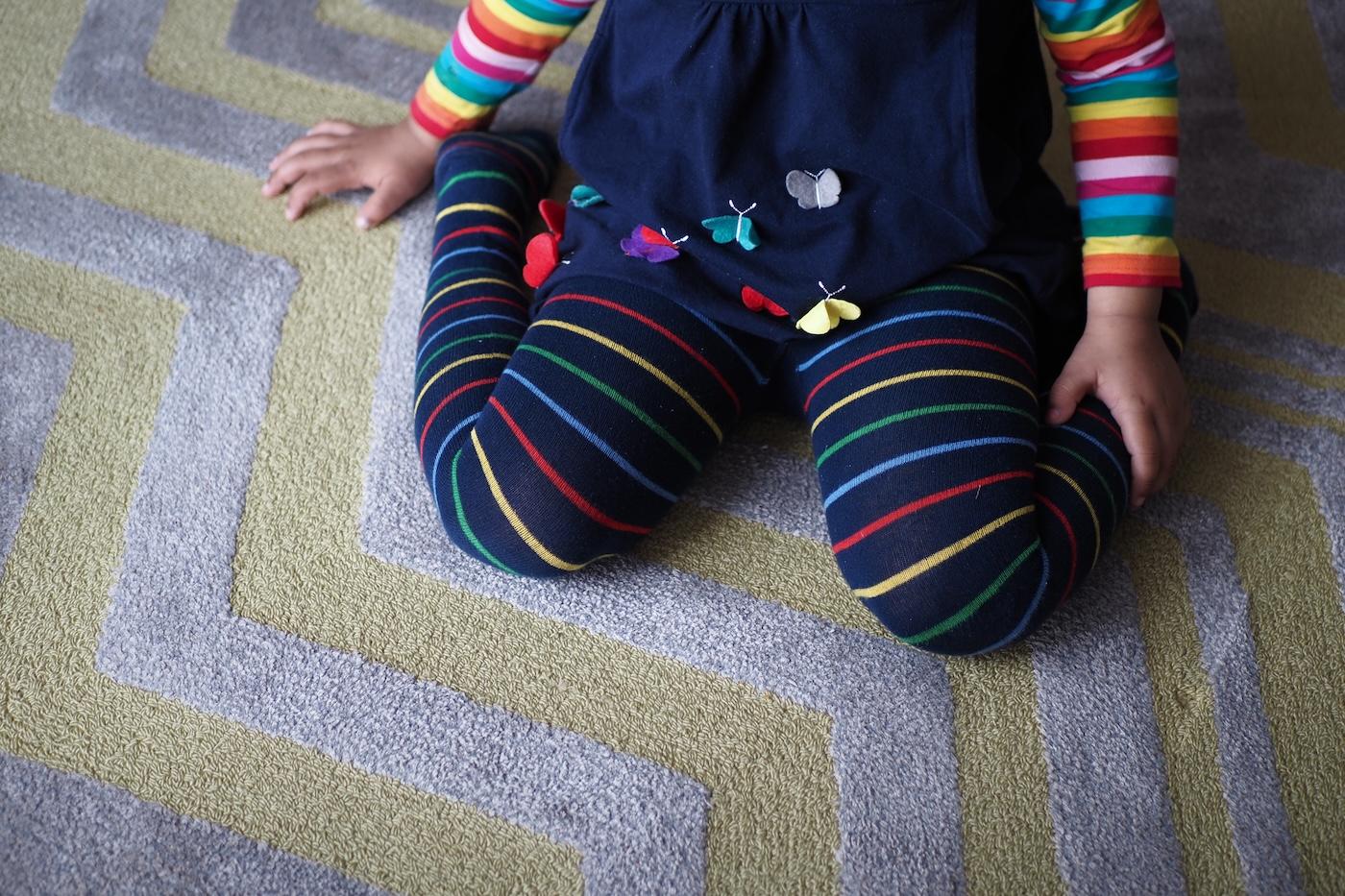
Kids have a knack for getting comfy in the strangest positions—whether it’s sleeping rump-up like little trussed chickens or folded up on the floor during playtime. But one seated position has drawn some side-eye: W-sitting.
This floor-sitting position has had a bit of a reputation problem—parents are told it will wreck their toddler's hips, weaken their core, or lock in a pigeon-toed walk for life. It's the kind of warning that gets repeated so often it starts to feel like established fact.
But when researchers went looking for evidence to back up those warnings, they came up mostly empty-handed. Below, we'll walk through what W-sitting is, why so many toddlers gravitate toward it, what the science does (and doesn't) say about its effects, and the handful of situations where it's genuinely worth a conversation with your child's healthcare provider.
What is W-sitting?
W-sitting describes exactly what it sounds like: A child sits on the floor with their bottom between their heels, knees bent and pointed forward, and feet splayed out to the sides. Viewed from above, the legs form a rough "W" shape. You'll sometimes hear it called "television sitting" because it's such a common position for playtime or screen time. It's an easy position to fall into (literally)—many toddlers slide into it naturally while transitioning from crawling into sitting, without any coaxing at all.
Why do kids W-sit?
The short answer is comfort and biomechanics. Nearly all babies are born with their thigh bones (femurs) twisted inward to some degree—a totally normal, usually inherited variation known as femoral anteversion. A clinical review in American Family Physician explains that this inward twist is present from birth and tends to run in families, generally showing up in both legs rather than just one. That built-in rotation happens to make the W position especially easy to hold, since it doesn't demand much hip or hamstring flexibility.
The same review points out that this inward hip rotation tends to be most obvious in the preschool years, is typically most pronounced around age 4 to 6 and then fades with time—which tracks closely with when W-sitting is most common, and with when most kids naturally drift away from it as their hips loosen up and the position stops feeling as comfortable.
W-sitting also offers a wide, stable base of support, which can make it an appealing option for a young child who's still building trunk control, or who simply wants a low-effort way to stay upright while playing with both hands free.
Is W-sitting bad for kids?
A 2025 systematic review published in Acta Ortopédica Brasileira set out to evaluate the evidence behind W-sitting warnings. The reviewers pointed out that plenty of professionals and nonprofessionals alike view W-sitting as harmful, even though solid science to back that up has largely been missing. After combing through the available studies, they landed on a reassuring bottom line: There isn't research to justify discouraging W-sitting, and no meaningful connection between the position and hip dysplasia. They also found that trunk muscle activation doesn't meaningfully change depending on which floor-sitting position a child (or adult) uses.
That last point is backed up by a small biomechanics study published in the journal Work, which measured muscle activity in the abdominal and back muscles across four common sitting postures. The researchers found that activity levels in the major trunk muscles were statistically similar across W-sitting, cross-legged, long, and side sitting.
Even American Family Physician's most recent update on lower-extremity development in children—used by family physicians nationwide—now includes a version of this same message as a formal clinical recommendation: Parents can be told that W-sitting doesn't cause the inward hip rotation some worry about, and that there's no real need to steer kids away from the position.
Does W-sitting cause hip dysplasia?
This is probably the most persistent W-sitting myth, and it's also the one researchers have studied most directly.
A prospective cohort study out of Children's Hospital Los Angeles compared hip X-rays in children with and without a history of W-sitting. As the International Hip Dysplasia Institute explains, the research to date hasn't turned up any evidence that W-sitting harms a child's developing hips or plays a role in hip dysplasia. The nonprofit organization—dedicated specifically to hip health in children—also notes that in the vast majority of kids, the inward femoral twist behind W-sitting resolves entirely on its own as they grow, and that keeping a child from W-sitting doesn't speed that process along.
A related review of pediatric orthopedic myths, published in Current Opinion in Pediatrics, reached a similar conclusion: The authors found no link between W-sitting and hip dysplasia, and no evidence that it leads to joint tightness, dislocations, or lasting functional problems.
Does W-sitting weaken core strength?
You may have heard that W-sitting is a "lazy" position that lets kids skip the core work needed for good posture. It's an intuitive idea—the wide base of support does mean a child doesn't have to actively balance the way they would sitting cross-legged. But as noted above, the direct EMG research measuring actual muscle activity hasn't found meaningful differences between W-sitting and other floor-sitting positions. In other words, the "weak core" concern is a reasonable-sounding hypothesis that simply hasn't held up when researchers have tested it.
Should you correct W-sitting?
Given all of the above, most pediatric orthopedic sources now suggest there's no medical need to interrupt or "correct" W-sitting when it shows up occasionally during play. It's a normal, common position for toddlers and preschoolers, and for most kids, it fades out on its own by mid-childhood as their hip rotation shifts—no intervention required.
That said, plenty of parents still feel more comfortable gently encouraging some variety in how their child sits, and that instinct isn't wrong, either—it just isn't medically necessary. Building comfort with a few different floor positions (more on that below) gives your child's growing body some helpful variety and can be a nice way to work in a little extra gross motor practice, even if it's not "fixing" anything that was actually broken.
How to Gently Encourage Other Sitting Positions
If you'd like to offer some variety without turning it into a battle, try these approaches:
- Model it, don't police it: Sit cross-legged or long-legged next to your child during playtime rather than repeatedly telling them to move their legs.
- Change the furniture, not the child: Offer a small table and chair, a floor cushion, or a low bench for some activities so sitting on the floor in any particular position becomes just one option among several.
- Build in movement breaks: Toddlers naturally shift positions when they're moving—rolling a ball back and forth, reaching for toys placed slightly out of reach, or getting up to dance—all encourage the hips and trunk to work through a wider range of motion.
- Skip the shaming: Since there's no evidence W-sitting causes harm, there's no need for repeated corrections, verbal reminders, or a tone of alarm. A relaxed, low-key approach (or none at all) is entirely reasonable.
When to Talk to Your Child's Healthcare Provider
Because the evidence doesn't support treating typical W-sitting as a medical problem, most kids who W-sit occasionally don't need any evaluation at all. That said, it's worth checking in with your child's healthcare provider if you notice any of the following, since these can be signs of something separate from ordinary W-sitting:
Your child seems to favor one side, or W-sits with only one leg while the other leg is positioned differently
Your child can only get in and out of a seated position with real difficulty or seems to have unusually limited hip movement
You notice a limp, persistent toe-walking, or a very awkward, uneven gait
Your child complains of hip, knee, or leg pain
Your child isn't meeting other expected gross motor milestones, like sitting independently, pulling to stand, or walking within a typical timeframe
There's a family history of hip dysplasia, or your child had risk factors for it as an infant (like breech position)
Intoeing or a pigeon-toed walk hasn't started to improve by around age 8
None of these are signs that W-sitting itself is the problem, they're simply signs that a healthcare provider should take a closer look at what's going on, since a physical exam can distinguish typical variation from something that may need support, like physical therapy.
The Bottom Line on W-sitting
If your toddler folds themselves into a W on the living room floor every single day, you can most likely relax. The research on W-sitting is reassuring: It doesn't appear to cause hip dysplasia, doesn't seem to meaningfully change how hard your child's core muscles are working, and typically resolves on its own as your child's hips naturally rotate with age.
There's nothing wrong with gently encouraging a mix of floor-sitting positions, just for variety's sake—but there's also no need to treat W-sitting itself as an emergency. Save your energy (and your reminders) for the things that matter, and let your kiddo enjoy their favorite floor spot in peace.
More on Toddler Development:
- When Do Babies Start Sitting Up?
- When Do Babies Crawl?
- 10 Gross Motor Activities for Toddlers
- How Toddlers Learn to Play
***
REFERENCES- Lower Extremity Abnormalities in Children, American Family Physician, Feb 2025
- W-Sitting in Childhood: A Systematic Review, Acta Ortopédica Brasileira, Jan 2025
- Comparison of Trunk Electromyographic Muscle Activity Depends on Sitting Postures, Work, Feb 2017
- Hip Dysplasia Is Not More Common in W-Sitters, Clinical Pediatrics, Jul 2020
- International Hip Dysplasia Institute: W-Sitting and Hip Development
- Pediatric Orthopedic Mythbusters: The Truth About Flexible Flatfeet, Tibial and Femoral Torsion, W-Sitting, and Idiopathic Toe-Walking, Current Opinion in Pediatrics, Feb 2021
Disclaimer: The information on our site is NOT medical advice for any specific person or condition. It is only meant as general information. If you have any medical questions and concerns about your child or yourself, please contact your health provider.
SHARE THIS ARTICLE
MOST LOVED
Sleepytime Sidekicks