PARENTS
Leslie Forde on Why Moms Put Themselves Last—and How to Stop
The founder of Mom’s Hierarchy of Needs talks burnout, the “never-done list,” and what parents really need.

Written by
Happiest Baby Staff
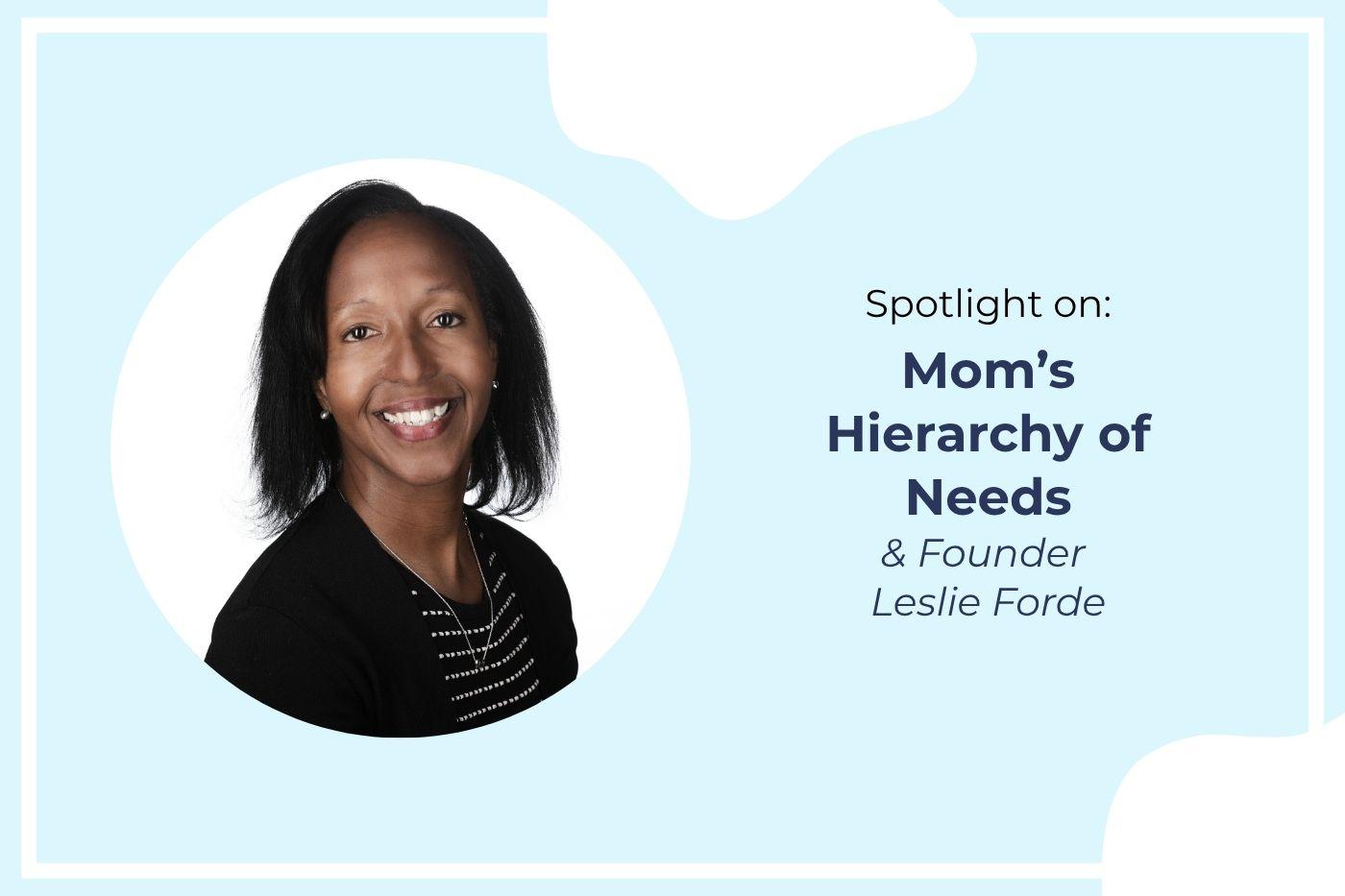
When Leslie Forde returned from her second maternity leave, she was running on 90-minute sleep cycles, navigating a workplace reorganization, and trying to bring her sharpest thinking to a role that had changed completely while she was gone. Something had to give—and, like so many parents before her, the thing she sacrificed was herself. She downshifted into a less demanding position, took a 40% pay cut, and spent the next two years slowly clawing her way back to feeling like a whole person.
That experience became the spark for Mom's Hierarchy of Needs®—a framework that flips Maslow's famous pyramid on its head to reveal what parents (and especially moms) actually prioritize, and what gets left behind.
We sat down with Leslie to talk about burnout, the "never-done list," what her research has revealed about what parents really need, and why infant sleep might be the single most important foundation for a mom's overall wellbeing.
Happiest Baby: You developed the Mom's Hierarchy of Needs framework back in 2017. Can you walk us through the "aha" moment that led you to create it?
Leslie Forde: I completely burned out after returning to work from my second maternity leave. When I was pregnant, I took on new responsibilities and when I came back, so much changed that I felt like I was in a new job. Not only was I short staffed, and navigating a reorganization, I was also being asked to bring my most strategic, clear-thinking self to my work when I was sleeping in 90 minute increments with a newborn and a toddler. Although my family was thriving, I was withering and the job I once loved became unsustainable so, I did something I never thought I’d do, I downshifted into a less demanding role and took a 40% pay cut.
Two years after that, when I was sleeping again and could string sentences together, a mental health founder approached me about an advisory role and asked, ‘why are moms so stressed?’ during a casual conversation. I immediately replied, well there’s Maslow’s Hierarchy of Needs and then there’s Mom’s Hierarchy of Needs®. It felt like an epiphany and moment of clarity, that everything moms really prioritize, like our children’s milestones, health and wellbeing, household roles and even our professional roles are perpetual responsibilities. As in, they’re never done!
When I realized that I could spend 24/7 just doing any one of those things, it freed me to become a bit ruthless with my time and make space for the activities at the top of the Mom’s Hierarchy of Needs, like sleep, stress management, nutrition, fun and interests.
I was curious if other moms felt the same way and because I solved my professional problems with research, I launched my first study and about 150 moms later, learned that I was not alone. Other moms were prioritizing in this way and felt like they didn’t really have any discretionary time after caring for kids, household and career to make space for their health and wellbeing.
Can you briefly describe for our readers what the Mom’s Hierarchy of Needs look like?
If you’re familiar with Maslow famous hierarchy of needs, the foundational categories like food and shelter are at the base, and aspirational categories like higher learning and self-actualization are at the top.
In the Mom’s Hierarchy of Needs framework, it demonstrates that we prioritize our children’s wellbeing and milestones as foundational. Followed by our household responsibilities and professional roles and the categories that are critical for our mental, physical and emotional health at the top—like self-care, which in my framework includes sleep, movement and stress management, along with fun, learning and healthy adult relationships—are often abandoned once we have kids. Because we’re conditioned to only spend time on ourselves when everything else “is done” we spin in circles with the never-done list and ignore our health needs.
Your framework suggests that moms get stuck at the base of the hierarchy (childcare, household tasks, the "never-done list") and rarely reach the top, where self-care and personal growth live. What's one small, realistic shift a new parent can make today to start climbing higher?
Find something very accessible, ideally something that you can do even when you only have 5 or 10 minutes, that fuels you. The key is that it has to be something you can do daily. I’ll often tell people, if hiking in the Swiss Alps is your idea of self-care, unless you live in the Swiss Alps it can’t be that. Even if that's taking a few deep breaths by yourself or splashing cold water on your face, which might be what's realistic if you have a newborn. If you give yourself that time even if it’s only a few minutes, the self-investment starts to shift your mood and expectations. It begins to spill over and have a positive effect in other areas of your life. When you begin to treat yourself well you will feel it and begin to demand better.
For example, running is my medicine. I run every single day outside so that I have the combination of movement, fresh air and time in nature as a way to reset in the mornings but there are many days that my schedule doesn't allow me to take a luxurious 3 or 4 mile run. Sometimes it looks like a rushed, 10 minute run in the rain because I have an early meeting. When my kids were babies, many times I brought them in the running stroller when I didn’t have coverage, or ran behind the scooter at the playground and although it’s not the same as running alone, I made that daily commitment to a routine that helps with my mental and physical health.
You've shared openly about burning out after your second maternity leave. What were the early warning signs you wish you'd recognized sooner, and what do you want other new parents to know about that experience?
I found it hard to think clearly, even when I was sitting by myself and had deep work to do like writing a strategy presentation or conducting research. My thoughts often came to me in distracted threads and if I sat down for more than a few minutes, I generally felt desperate to take a nap. For the first time in my life, other people asked me if I was OK because I did not look like I was doing well. I was also cranky and exhausted. Although I was overjoyed with the birth of my daughter and completion of our family, my daily responsibilities felt draining and I started to dread them.
You've built a TimeCheck® tool that helps moms assess how they're really doing. How does it work, and what patterns do you tend to see in the results?
I realized that I kept getting the same types of questions when I ran employee workshops or training programs with mothers about how to start and sustain a self-care practice, when their lives were so filled with so many commitments. My original idea was to take these questions that I would ask people during live workshops, to assist them with creating and customizing a self-care plan and put them into a very accessible technology based quiz.
I also wanted to ensure that the “intake process” was quick, easy and not dripping with assumptions or judgement because moms are often inclined to feel guilty, about what they do or don’t do. And to make progress, it’s really important to let go of the idea that you are ‘not committed enough’ or ‘lack willpower’ because those are the messages that tend to come up in our society when people are not taking care of themselves. Most mothers, however, lack discretionary time. You can have all the willpower in the world, and someone might decide to throw up on you when you're ready to go have your workout. TimeCheck takes less than a minute a week, to track how much time you're spending on those mental physical and emotional health categories at the top of the Mom's Hierarchy of Needs framework. And when you notice how you're spending your time and you become really aware of your self-care activities and begin to protect that time because you naturally become more intentional about it.
A big part of your work focuses on the role employers play in supporting parents and caregivers. What's one thing you wish every manager understood about what working moms actually need?
Managers need to know that parents and caregivers want to be excellent at everything and most of the time, they will break themselves in half to try to accomplish goals and meet deadlines even when it's not desirable. A simple shift is for leaders to ensure they give a deadline when new projects are assigned and adjust other priorities if needed. Provide opportunities to discuss and revisit existing projects and reassign, adapt or pause work, based on changes in available resources and conditions. In my research study, what I consistently hear is that mothers are being asked to meet the same performance goals with half the staff or a third of the budget and not only is it unsustainable, but when parents burn out everybody loses. It’s devastating for caregivers, the organization and their families.
Your post-pandemic research study has followed over 3,700 parents since 2020. What finding has surprised you the most?
There was a point in the research study, when parents were asked, ‘what do you need to be happy’ or ‘productive’ or to ‘take care of yourself’ where the top answers were the same for each question. Childcare, flexibility at work, and access to mental health care. Infrastructure really matters for caregivers, especially mothers in our personal and professional lives and it does take time not only to set up a system that enables you to engage in behavioral health practices but one that allows you to evolve it over time. Our kids keep growing, while the economy and conditions in the world keep shifting so, being poised to revisit your needs frequently as everything changes is critical. And difficult to do if you already feel exhausted or under supported.
Sleep deprivation is one of the biggest stressors for new parents—and it touches almost everything else in the hierarchy. How do you see infant sleep fitting into the bigger picture of a mom's wellbeing?
As I share in my book, the fact that neither of my children slept through the night until they were 14 months old was a foundational part of my story, including the burnout that ultimately unraveled my wellbeing and reshaped my career. Nothing quite prepares you for prolonged months of sleep deprivation and it becomes an unmanageable way of life quickly. Although I sought different sources of help and to educate myself about the best ways to get both kids to sleep, I eventually gave up on it because nothing worked and in hindsight bringing in more expertise and resources until I was able to get them to sleep in age appropriate ways should have been a higher priority than it was. Nothing will quite dissolve your goodwill or clarity like not sleeping for weeks and months. It's also healthier and better for our children to get proper sleep at all stages of their lives.
What's a piece of advice you'd give to a parent who's deep in the early months and feeling like they've completely lost themselves?
Two things:
1. Ask for help and hands-on support from the people you are closest to. Ideally, the people who love you and will actively advocate for and protect your best interests. Often, it’s those people who you feel the most comfortable being vulnerable with and who will give you the loving, candid feedback and relief you need. Who can hold the baby for a few hours so you can rest on a regular basis? Who will make meals for you during the week, watch older children you may have or pick up groceries or takeout? In my life, this would be my own mother or my sister, but it doesn’t have to be family, this could be your partner if partnered or a close friend.
2. Build community with other moms who have children at the same or similar stages and ages. You will not only feel the gift of solidarity, but other moms will also become your lifelines for sage advice, laughter, and support in ways that you can't imagine.
How much time do you spend on self-care? Find out, in less than 1 minute per week.
Disclaimer: The information on our site is NOT medical advice for any specific person or condition. It is only meant as general information. If you have any medical questions and concerns about your child or yourself, please contact your health provider.



SHARE THIS ARTICLE