PARENTS
6 Simple Ways to Strengthen Grandparent-Grandchild Relationships
A close bond with a grandparent isn't just a nice-to-have—it can impact child wellbeing for years!

Written by
Happiest Baby Staff
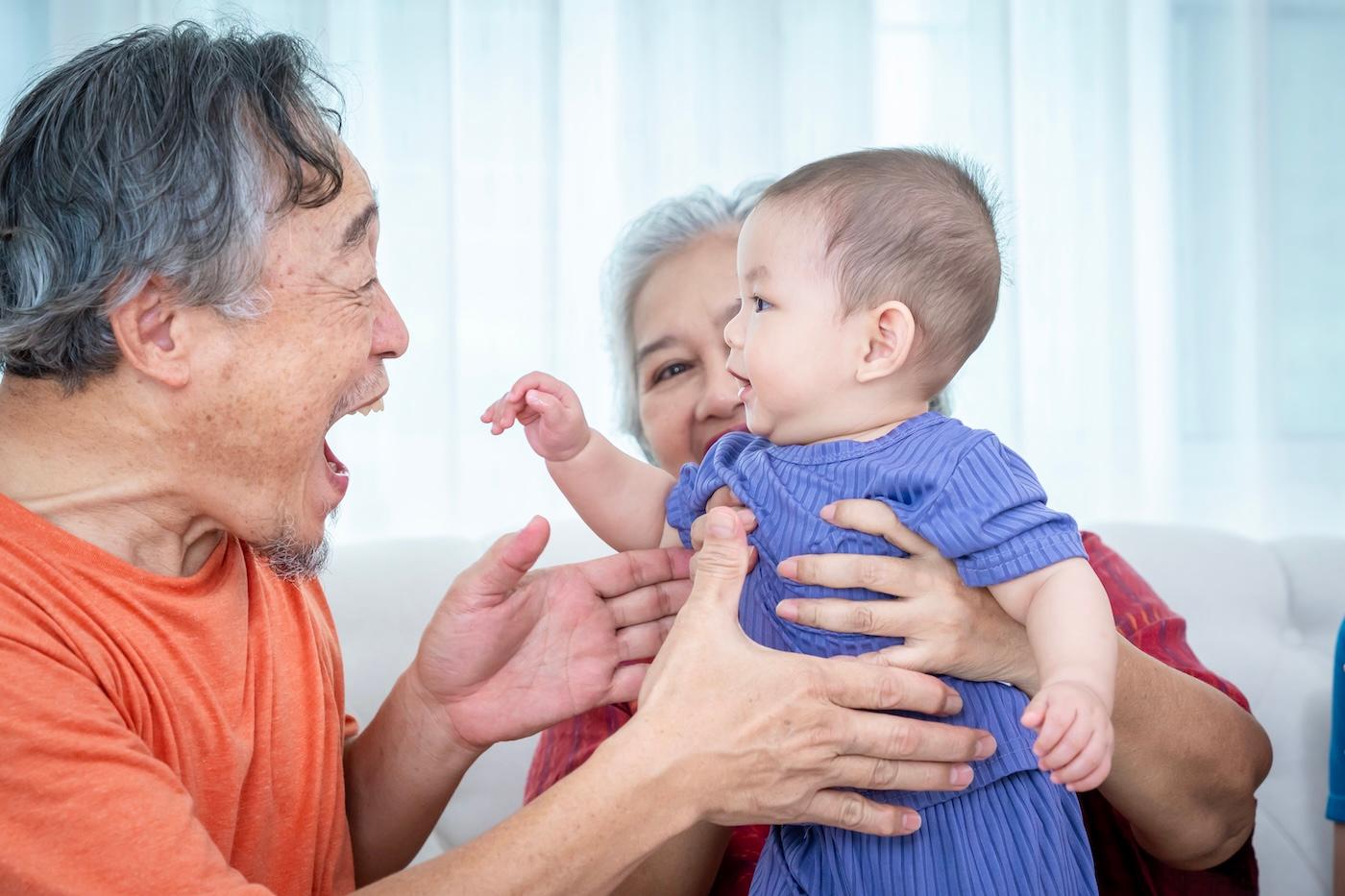
A close bond with a grandparent isn't just a nice-to-have—research links warm grandparent relationships to fewer emotional and behavioral problems in kids, so a few intentional moves from you now can pay off in your child's wellbeing for years. Here's how to help that bond grow into something real, rather than leaving it to chance.
Give Grandparents a job, not just a visit.
"Come by whenever!" feels generous, but it can be a little paralyzing. Grandparents often don't know what role they're supposed to play, so they default to spectator: sitting on the couch, admiring from a distance, waiting to be told what to do. Instead, hand them something specific and recurring. Maybe Grandpa is the designated pancake-flipper every Sunday. Maybe Grandma is the one who always does bath time when she visits. Research on how grandparents spend time with grandchildren finds they tend to settle into distinct roles—babysitter, playmate, confidant—and the relationship gets stronger when that role is clear rather than improvised every time. A defined job also gives grandparents an identity in your child's world that's theirs alone, not a watered-down version of your own parenting.
Make video calls a shared activity.
Toddlers and babies don't engage well with open-ended small talk on a screen, but they light up for shared activities. Child development researchers who study video chat with young children recommend turning the call into a mini shared experience: reading the same book together, playing peekaboo, or having your toddler show off a toy or share a snack through the screen. In one home study, toddlers were far more engaged when calls centered on playful, back-and-forth activities like hide-and-seek or feeding a snack "through" the screen than when the call was just a passive check-in. Keep a small basket of the same books or toys by the phone charger so Grandma's copy matches yours—it turns "checking in" into an actual ritual kids look forward to.
Hand down the family stories.
Stories do more than entertain—they help kids build a sturdier sense of who they are. In a well-known line of research out of Emory University, psychologist Dr. Marshall Duke found that kids who knew more about their family's history showed higher self-esteem, more self-control, and fewer behavioral or anxiety problems than kids who didn't. You don't need a formal family history project to tap into this. Just ask grandparents to tell your child one specific story on each visit or call—how they met your other parent, a childhood mishap, what your family struggled through and got past. Save the "Once upon a time" openers for books; "Let me tell you about the summer Grandpa lost the family dog" is the kind of story that sticks.
Loop them in before the baby arrives.
Most grandparent-bonding advice starts after the baby's born, but the relationship can start earlier than that. Give expecting or soon-to-be grandparents a specific, meaningful task during pregnancy: picking out a family name to pass down as a middle name, choosing one heirloom item for the nursery, or being the one who gets the "we're pregnant" news in person before the group text goes out. Small, tangible involvement early on tends to make grandparents feel like participants in your family's story instead of guests who get updates after the fact—and it gives them something to be genuinely invested in well before the baby ever opens their eyes.
Let closeness carry the weight, not rule enforcement.
It's tempting to measure a good grandparent-grandchild relationship by how well Grandma and Grandpa follow your rules. But warmth matters more than compliance. A study of over 1,400 adolescents found that emotional closeness with a grandparent was linked to fewer adjustment difficulties—especially for kids who were also close with their parents. In other words, a grandparent who's a soft landing spot isn't undermining your parenting; they may be reinforcing your child's overall stability. That doesn't mean tossing out every house rule (see our guide on setting boundaries with grandparents for that). It means resisting the urge to treat every visit as a compliance check, and trusting that the warmth itself is doing real work.
Build a standing date, just the two of them.
Big family gatherings are wonderful, but they're not where deep bonds form. A recurring solo date, even a short one, gives your child and their grandparent a relationship that's separate from you. Think: a standing Tuesday library trip, a monthly "just us" lunch, a bedtime call that's theirs alone. It doesn't need to be elaborate or expensive. What matters is that it's consistent and it belongs to the two of them, without a parent narrating or refereeing. Over time, those small, repeated one-on-one moments are what turn "Grandma who visits" into "Grandma who's mine."
More Grandparent Guidelines:
- How to Set Boundaries with Grandparents
- How New Grandparents Can Build an Extra-Sweet Bond With Baby
- How to Teach Caregivers About Safe Sleep
***
REFERENCESEmotional Closeness to Parents and Grandparents: A Moderated Mediation Model Predicting Adolescent Adjustment, American Journal of Orthopsychiatry, Sep 2015The Influence of Grandparents on the Lives of Children and Adolescents, Child Development Perspectives, Mar 2013Backup Parents, Playmates, Friends: Grandparents' Time With Grandchildren, Journal of Marriage and Family, Jun 2018"Do You Know?" The Power of Family History in Adolescent Identity and Wellbeing, Journal of Family Life, Feb 2010Virtual Family Time: How Families Connect via Video Chat, ZERO TO THREE Journal, Dec 2020
Disclaimer: The information on our site is NOT medical advice for any specific person or condition. It is only meant as general information. If you have any medical questions and concerns about your child or yourself, please contact your health provider.

SHARE THIS ARTICLE
MOST LOVED
Sleepytime Sidekicks