PREGNANCY
Can I Sleep on My Stomach While Pregnant?
If stomach sleeping has long been your go-to, pregnancy can throw a real wrench into your nightly routine.

Written by
Happiest Baby Staff
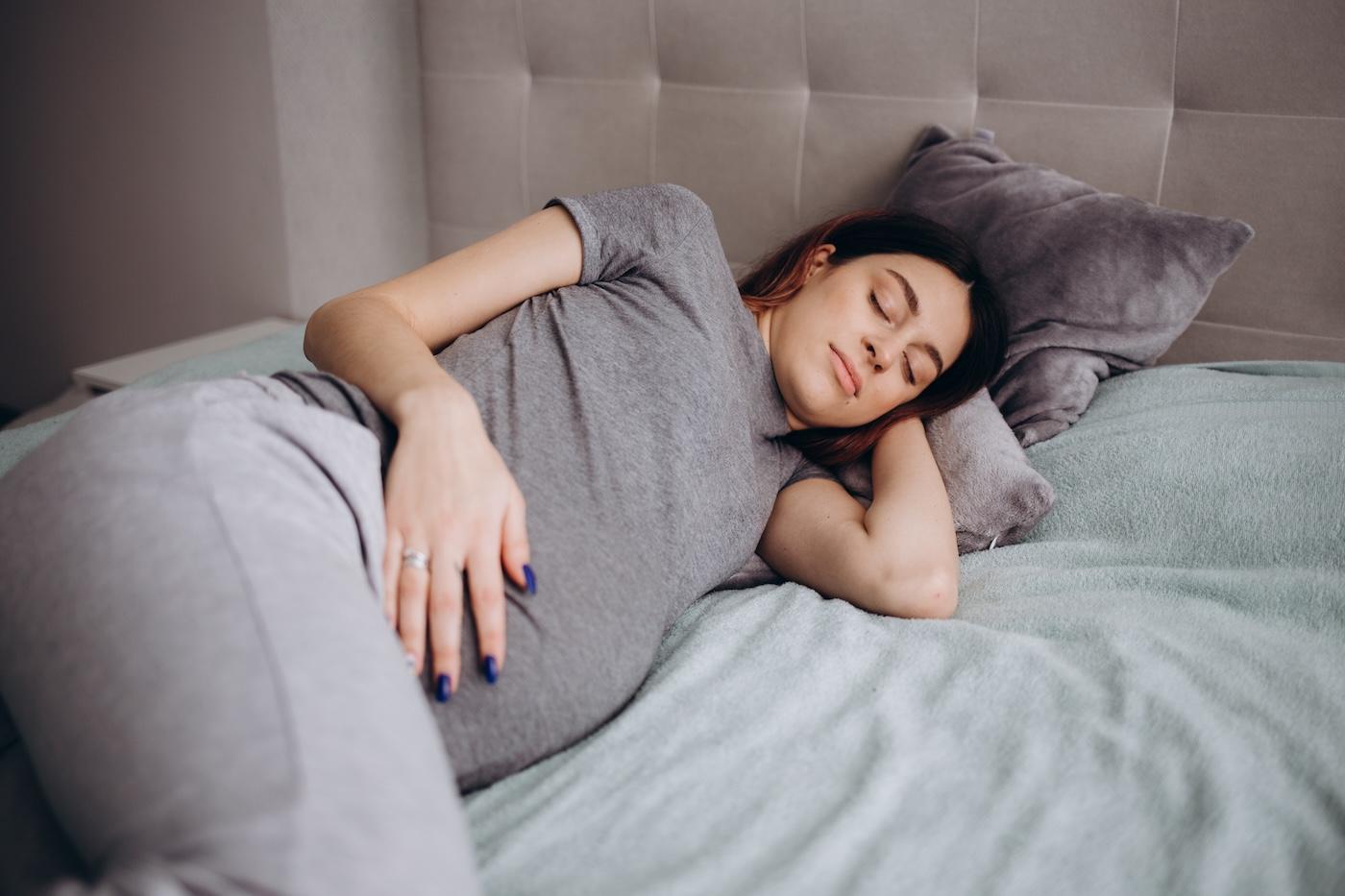
There's nothing like finally getting comfortable in bed—only to remember you're not supposed to sleep the way you always have. If stomach sleeping has long been your go-to, pregnancy can throw a real wrench into your nightly routine, leaving you to wonder: Is it safe to sleep on my stomach while pregnant? And if not, when exactly do I need to stop? Here's what the evidence says, trimester by trimester.
Can you sleep on your stomach while pregnant?
Stomach sleeping doesn't harm your baby, and in the first trimester it's a totally normal position to fall asleep in. As your uterus and breasts grow, though, lying face-down naturally stops being comfortable, and most people shift to their side well before it becomes a real question of safety versus preference.
Is stomach sleeping safe in the first trimester?
Completely. In the early weeks, your uterus is still a small, low-lying pelvic organ, tucked behind your pubic bone and cushioned by amniotic fluid—so there's no meaningful pressure on your baby when you lie face-down. In an ACOG-published essay on the questions she hears most from first-time moms, one OB/GYN put it simply: You can sleep on your belly, but you'll eventually reach a point where it's just not possible anymore. In other words, in early pregnancy the question isn't really "is this safe?" so much as "how long will this stay comfortable?"
When (and why) does stomach sleeping become uncomfortable?
There's no fixed week when you're required to stop—let your own comfort level take the lead. For most people, somewhere between the end of the first trimester and partway through the second, stomach sleeping starts to lose its appeal. A few things are going on:
- Your uterus grows out of the pelvis: Once it rises above the pubic bone, there's no longer a bony "shelf" to rest on.
- Breast tenderness increases: Hormonal shifts in pregnancy make breasts more sensitive early on, which can make face-down sleeping uncomfortable well before your belly is in the way.
- Sleep changes across pregnancy in general: Rising estrogen and progesterone levels during pregnancy can shift sleep patterns, and weight gain can make the airway swell, contributing to snoring and obstructive sleep apnea, so it's common to just sleep differently than you used to, regardless of position.
What about the second and third trimester—does stomach sleeping get risky?
The evidence on stomach sleeping is reassuring. A 2021 review from the UK's National Institute for Health and Care Excellence (NICE), published via the National Library of Medicine, pooled data from five case-control studies to look at how different sleep positions related to stillbirth risk. The analysis found no significant association between going to sleep in a prone (stomach) position and stillbirth, compared with sleeping on the left side. That said, the researchers noted this finding was based on a small number of prone-sleepers in the data, so it's considered low-certainty—not as much of a green light as an absence of red flags.
The real limiting factor by the second trimester is usually mechanical, not medical. By 20 to 28 weeks, most people's bumps make true stomach-down sleeping physically impossible without a specialty cutout pillow! Even then, spinal alignment and neck strain tend to make it more trouble than it's worth.
Why is side-sleeping recommended over back-sleeping?
Since face-down sleeping isn't usually an option by the second half of pregnancy, the real choice most people are making is between their side and their back—and here, the guidance is much clearer. As your belly grows, sleeping on your back may not be good for you, since it puts weight of your uterus on your spine and back muscles, and in the second and third trimesters, lying on your back may compress a major blood vessel that carries blood to your uterus, which can make you feel dizzy and may reduce blood flow to your fetus. That's why ACOG recommends side-sleeping in the second and third trimesters, ideally with one or both knees bent, a pillow between your knees, and another under your belly or a full-length body pillow for support.
The NICE evidence review backs this up with numbers: a meta-analysis of five case-control studies found that going to sleep on your back was associated with roughly 2.6 times the odds of stillbirth compared with going to sleep on the left side. Right-side sleeping, on the other hand, showed no meaningfully increased risk compared with the left side—so despite what you may have read, you don't have to white-knuckle it on your left all night. As one ACOG-affiliated OB/GYN noted, a lot of people read online that they have to sleep on their left side for the entirety of pregnancy, but that's difficult to maintain and not actually necessary.
How to Sleep Comfortably as Your Bump Grows
- Enjoy any position in the first trimester, stomach included, if it's what feels best.
- Ease into side-sleeping by the second trimester, even before it's strictly required to make the transition less jarring later.
- Use pillows generously. A pillow between the knees and one under the belly (or a full-length body pillow) can make left- or right-side sleeping far more comfortable.
- Use a donut-style pregnancy pillow with a belly cutout if you miss your stomach. It can let you approximate the position for short stretches without straining your neck and back.
- Don't stress about switching positions overnight. Rotating sides is normal and fine.
What if I wake up on my stomach or back?
Don't panic. Brief, unintentional stretches of time in these positions overnight aren't dangerous—it's the position you settle into and spend the bulk of the night in that matters most. If you wake up on your stomach or back, simply roll onto your side and go back to sleep.
When to Call Your Doctor or Midwife
Reach out to your OB/GYN or midwife if you experience:
- Dizziness or lightheadedness when lying down that doesn't ease when you switch to your side
- Trouble sleeping that's significantly affecting your daily life or mood
- Loud snoring, gasping, or pauses in breathing during sleep
- Any symptom that worries you, including a noticeable decrease in your baby's movements
FAQ
Will sleeping on my stomach hurt my baby?
No. Early in pregnancy, your baby is well protected by the uterus, amniotic fluid, and your own pelvis and abdominal muscles. Later on, stomach sleeping simply becomes too uncomfortable to sustain. It's your body's cue to switch positions, not a safety alarm.
When should I stop sleeping on my stomach?
There's no strict cutoff. Most people phase it out naturally sometime in the first or second trimester as the bump grows.
Is it better to sleep on my left side than my right?
Left-side sleeping is often recommended and may offer a slight edge for circulation, but research hasn't found a meaningfully increased risk with right-side sleeping compared with the left. Whichever side is more comfortable for you is a reasonable choice.
What if I can't fall asleep on my side at all?
Try a pillow between your knees, a wedge or full-body pillow under your belly, or slightly elevating your upper body if heartburn is part of the problem.
More on Resting During Pregnancy:
- Pregnancy Fatigue: An Exhaustive Guide to Your Exhaustion
- Pregnancy Guide to Better Sleep
- Pregnancy Insomnia: Why Sleep Is Such a Struggle
- Why Meditation During Pregnancy Matters
***
REFERENCES- American College of Obstetricians and Gynecologists: The Top 6 Pregnancy Questions I Hear From First-Time Moms
- American College of Obstetricians and Gynecologists: Sleep Health and Disorders
- National Guideline Alliance (UK) / NICE, via National Library of Medicine: Maternal Sleep Position During Pregnancy — Antenatal Care Evidence Review
- American College of Obstetricians and Gynecologists: Can I Sleep on My Back When I'm Pregnant?
Disclaimer: The information on our site is NOT medical advice for any specific person or condition. It is only meant as general information. If you have any medical questions and concerns about your child or yourself, please contact your health provider.


SHARE THIS ARTICLE