PREGNANCY
Can I Sleep on My Back While Pregnant?
Don’t lose ZZZs over your snoozing position—get the facts on back-sleeping in pregnancy.
Written by
Happiest Baby Staff
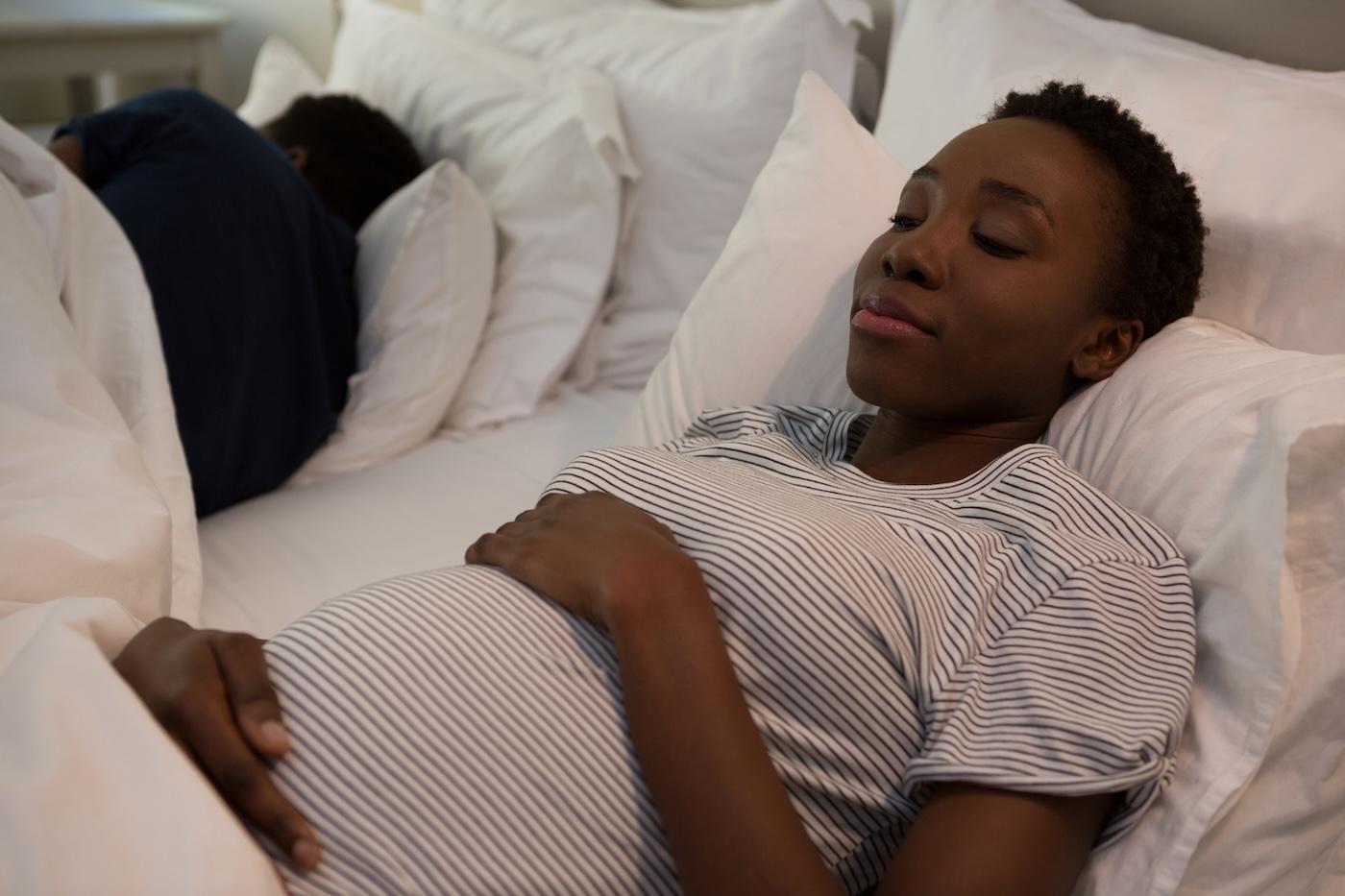
The Short Answer: Early on, yes. In the first half of pregnancy, sleeping on your back is fine. But as your bump grows, lying flat on your back can press on a major vein and leave you feeling dizzy—and from 28 weeks, research links going to sleep on your back with a higher risk of stillbirth. So in the third trimester, settle in on your side (left or right both count!). And if you wake up on your back? Just roll over—no need to panic!
If you've been a devoted back sleeper your whole life, pregnancy can throw a real wrench into your bedtime routine. Somewhere between your first ultrasound and your third trimester, you've probably heard that sleeping on your back is a no-no…and maybe you've even jolted awake at 3am, flat on your back, wondering if you did something wrong. (You didn't!) Here's what the research says about sleeping on your back while pregnant, when the advice kicks in, and how to get comfy on your side.
Is it safe to sleep on your back while pregnant?
In early pregnancy, yes—sleep however you like. A large study funded by the National Institutes of Health (NIH) followed more than 8,700 first-time pregnant people and found that going to sleep on the back or right side through about 30 weeks was not linked to stillbirth, smaller babies, or high blood pressure disorders of pregnancy. The researchers were clear, however, that their study didn't look at sleep position in late pregnancy.
Later in pregnancy, it's a bit of a different story. The American College of Obstetricians and Gynecologists (ACOG) notes that in the second and third trimesters, lying on your back can squeeze a major blood vessel, which may make you feel dizzy and possibly reduce blood flow to your baby-to-be. ACOG suggests side-sleeping may be best during those months. And from 28 weeks, the guidance gets firmer: The UK's National Institute for Health and Care Excellence (NICE) advises pregnant people to avoid going to sleep on their backs after 28 weeks, and a 2025 review in the Canadian Medical Association Journal recommends that clinicians share this advice with all pregnant patients, regardless of risk factors.
Why is back-sleeping a concern later in pregnancy?
It all comes down to plumbing. Your inferior vena cava—a large vein that carries blood from your lower body back to your heart—runs right alongside your spine. When you lie flat on your back, your growing uterus can rest on that vein (and on the aorta, your body's main artery), slowing the flow of blood back to your heart. This is called aortocaval compression, or supine hypotensive syndrome, and it typically shows up after about 20 weeks of pregnancy.
Why does that matter? By the end of pregnancy, your uterus commands roughly 10 times more blood flow than it did before you were pregnant—so even a modest dip in circulation can affect both you and your baby. When compression happens, it can cause dizziness, nausea, sweating, a drop in blood pressure, and a racing heart, and it can limit blood flow to the placenta. The good news: Symptoms typically ease as soon as you turn onto your side.
Researchers also suspect that breathing disruptions during sleep, which tend to be worse when lying on your back, may play a role.
What are the risks of sleeping on your back while pregnant?
Higher Risk of Late Stillbirth
This is the finding that has made headlines—and understandably worries a lot of expecting parents. A 2019 analysis pooled data from five studies, including 851 people who'd had a stillbirth and 2,257 people with ongoing pregnancies. It found that going to sleep on your back from 28 weeks onward was associated with about 2.6 times the odds of late stillbirth compared with going to sleep on the left side. The researchers estimated that roughly 6% of late stillbirths could be linked to back-sleeping. The largest single study, conducted across 41 maternity units in the United Kingdom, found a similar 2.3-fold increase.
Before you lose sleep over this, some crucial context:
- Stillbirth is uncommon: In the UK, where much of this research was done, around 1 in 225 pregnancies ends in stillbirth. Doubling a small risk still leaves a small risk—but side-sleeping is an easy way to make it even smaller.
- These studies show an association, not proof of cause: Most asked about sleep position after a pregnancy loss, which can introduce recall bias—the tendency to remember details differently after a painful event. That said, the link has shown up consistently across countries and study designs.
Smaller Babies
Going to sleep on your back in late pregnancy has also been associated with having a baby who's small for their gestational age—roughly three times the odds compared with other positions, according to a secondary analysis of the stillbirth data.
Dizziness and Discomfort
Even setting stillbirth research aside, back-sleeping can simply feel lousy as your bump grows. Lying on your back puts the weight of your uterus on your spine and back muscles, which can make pregnancy back pain worse—and vena cava compression can leave you lightheaded.
When should you stop sleeping on your back while pregnant?
First Trimester
Sleep in whatever position feels best. There's no evidence that back-sleeping early in pregnancy causes any harm.
Second Trimester
This is a transition period. As your belly grows, you may start to feel dizzy or uncomfortable on your back—aortocaval compression usually begins after about 20 weeks—and ACOG suggests side-sleeping may be best. It's a smart time to start practicing. But current evidence suggests that sleep position before 28 weeks does not affect pregnancy outcomes, so don’t sweat if you catch yourself on your back now and then.
Third Trimester (28 Weeks and Beyond)
This is when going to sleep on your side really counts. Guidance from NICE and a UK hospital research team advises settling onto your side for every sleep in the third trimester, including:
- Going to sleep at night
- Falling back asleep after waking up during the night
- Daytime naps
Even the authors of the large U.S. study that found no risk before 30 weeks have said they support side-sleeping recommendations at the end of pregnancy.
Is it better to sleep on your left or right side?
You've probably heard that the left side is the "gold standard." But when it comes to stillbirth risk, the research shows that going to sleep on either side appears equally safe. The UK's National Health Service (NHS) says the same: Left or right, both are safe positions to fall asleep in.
That said, the left side may offer a small bonus if you're battling pregnancy heartburn, since the NHS notes that sleeping on your left side can help ease indigestion. Bottom line? Pick the side that lets you actually sleep—and feel free to switch it up.
What if you wake up on your back?
Simply roll back onto your side and drift off again. Shifting positions during the night is completely normal, and experts say you shouldn't worry if you wake up on your back.
Here's why the advice focuses on the position you fall asleep in: It tends to be the one you hold the longest. One sleep study found that pregnant people who went to sleep on their backs spent, on average, about half the night on their backs, compared to about one-third of the night for those who simply woke up on their backs. So, starting each sleep on your side does a lot of the heavy lifting for you.
And for extra reassurance: In a trial of people more than 28 weeks pregnant who were actively trying to avoid back-sleeping, participants still spent roughly an hour per night on their backs. In other words, nobody sleeps perfectly—and you don't need to, either.
How to Sleep Comfortably on Your Side While Pregnant
If you're a lifelong back sleeper, switching to your side can feel awkward at first. These tips can help:
- Bend your knees: ACOG recommends keeping one or both knees bent while side-sleeping.
- Pile on the pillows: Tuck a pillow between your knees and another under your belly, or try a full-length body pillow for support.
- Wedge a pillow behind your back: It makes rolling onto your back less likely and less comfortable.
- Don't feel pressured to splurge: A randomized trial found that regular pillows and pregnancy pillows were equally effective at reducing back-sleeping in late pregnancy. Use what's comfortable!
- Give naps the same treatment: Daytime snoozes count, too, so settle in on your side whenever you lie down to rest.
- Tame nighttime heartburn: Propping up your head and shoulders, eating smaller meals, and skipping food within three hours of bedtime can keep acid where it belongs.
When to Call Your Healthcare Provider
There are several urgent maternal warning signs that warrant medical care ASAP. A few that are especially relevant at bedtime:
- Dizziness or fainting: Feeling a little woozy on your back should pass once you turn onto your side. If you faint, or you have dizziness that's ongoing or keeps coming back, get care right away.
- Trouble breathing when lying flat: If you suddenly feel short of breath or need to prop your head up with pillows just to breathe, contact your provider immediately.
- Changes in your baby's movement: If you feel like your baby has stopped moving or is moving less than usual, call right away. There's no "normal" number of kicks—a change in your baby's pattern is what matters. (Learn more about kick counting.)
Anything that just doesn't feel right: You know your body best. Never hesitate to reach out.
FAQ on Back-Sleeping
Can I sleep on my back in the first trimester?
Yes. Research shows that sleep position early in pregnancy isn't linked to complications, so sleep in whatever position is most comfortable.
What happens if I accidentally sleep on my back while pregnant?
Don't worry—just roll onto your side when you notice. Expert guidance focuses on the position you go to sleep in, because that's the position you tend to hold the longest. Shifting around during the night is normal.
When should I stop sleeping on my back during pregnancy?
You may find back-sleeping uncomfortable by the second trimester, and ACOG suggests side-sleeping may be best from then on. The strongest guidance applies from 28 weeks of pregnancy, when you should aim to fall asleep on your side for every sleep.
Does it have to be my left side?
No. Research shows going to sleep on your left or right side appears equally safe. The left side may help ease heartburn, but choose whichever side lets you rest.
Is it okay to lie on my back while exercising or doing prenatal yoga?
ACOG recommends avoiding lying flat on your back as much as possible during exercise, since your uterus can press on a large vein that returns blood to your heart. Modify moves or ask your instructor for side-lying alternatives. (Learn more about exercise during pregnancy.)
More on Pregnancy Sleep:
- The Importance of Third Trimester Sleep
- Pregnancy Insomnia: Why You Struggle to Sleep When Expecting
- Pregnancy Guide to Better Sleep
- Can You Take Melatonin While Pregnant?
***
REFERENCES- Prospective Evaluation of Maternal Sleep Position Through 30 Weeks of Gestation and Adverse Pregnancy Outcomes, Obstetrics & Gynecology, Oct 2019
- Eunice Kennedy Shriver National Institute of Child Health and Human Development (NICHD): Science Update: Sleeping Position During Early and Mid Pregnancy Does Not Affect Risk of Complications, NIH-Funded Study Suggests
- American College of Obstetricians and Gynecologists: Can I Sleep on My Back When I'm Pregnant?
- National Institute for Health and Care Excellence: Antenatal Care
- Sleeping Posture in Pregnancy, Canadian Medical Association Journal, Jun 2025
- National Institute of Health National Library of Medicine StatPearls: Aortocaval Compression Syndrome
- Manchester University NHS Foundation Trust: New Research Confirms That the Risk of Stillbirth Is Doubled if Women Go to Sleep on Their Backs in the Third Trimester
- An Individual Participant Data Meta-analysis of Maternal Going-to-Sleep Position, Interactions with Fetal Vulnerability, and the Risk of Late Stillbirth, EClinicalMedicine, Apr 2019
- Association Between Maternal Sleep Practices and Late Stillbirth—Findings From a Stillbirth Case-Control Study, BJOG: An International Journal of Obstetrics and Gynaecology, Nov 2017
- Prospective Evaluation of Maternal Sleep Position Through 30 Weeks of Gestation and Adverse Pregnancy Outcomes, Obstetrics & Gynecology, Jan 2020
- National Health Service: Tiredness and Sleep Problems in Pregnancy
- NHS: Indigestion and Heartburn in Pregnancy
- Centers for Disease Control and Prevention (CDC): Urgent Maternal Warning Signs and Symptoms
- ACOG: Exercise During Pregnancy
Disclaimer: The information on our site is NOT medical advice for any specific person or condition. It is only meant as general information. If you have any medical questions and concerns about your child or yourself, please contact your health provider.
SHARE THIS ARTICLE