BABY
Should Babies Be in a Car Seat on an Airplane?
Flying with your baby in your lap sounds like a good deal, but is it recommended?

Written by
Happiest Baby Staff
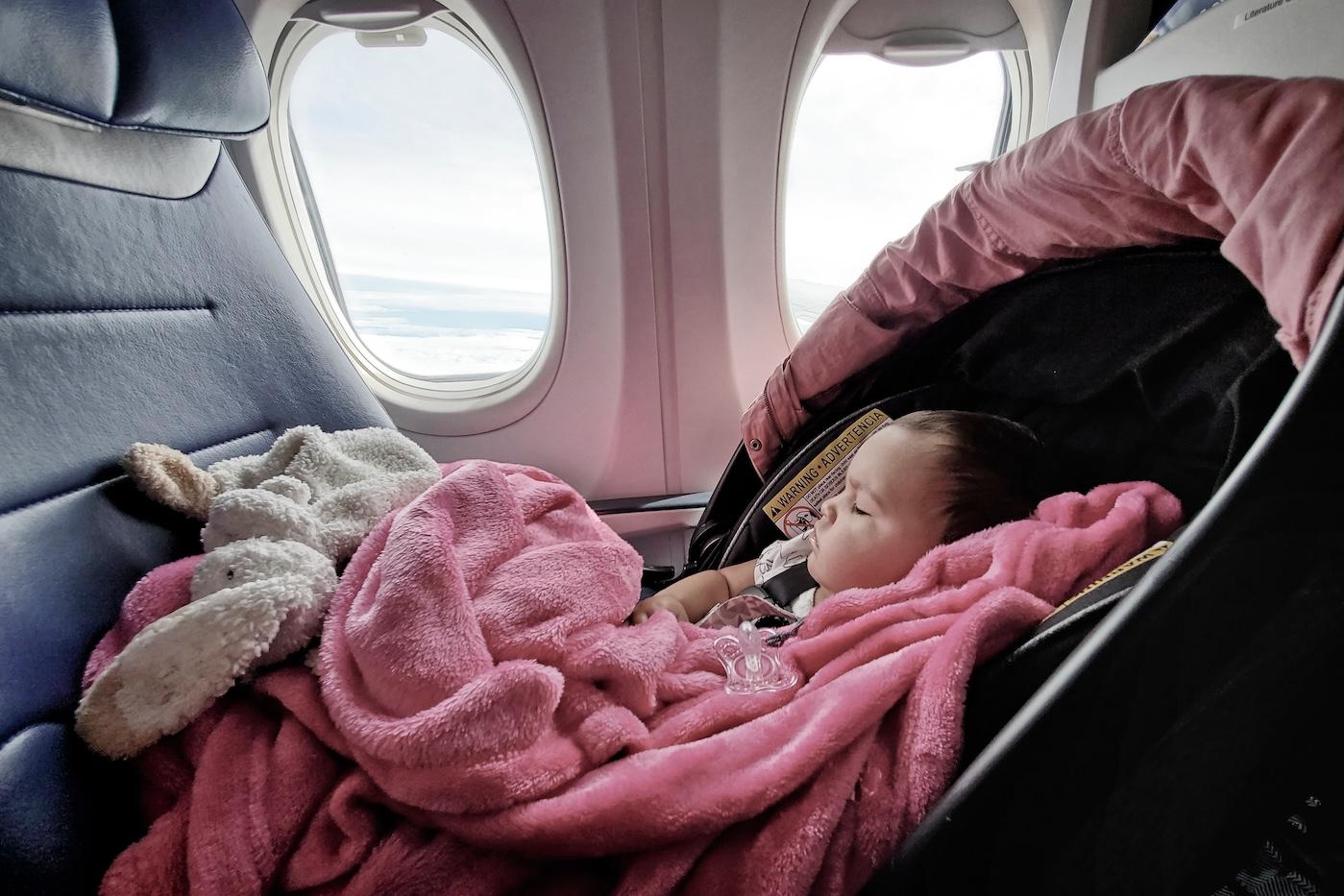
When you're booking baby's first flight, that "lap infant" option can look awfully tempting. It's cheap (sometimes free!), and it means one less bulky thing to haul through the airport. But here's the question every parent eventually asks somewhere around 30,000 feet: Is my baby really safe like this?
The short answer from the experts is that your baby is safer in their own seat, strapped into a car seat that's approved for aircraft. Let's walk through why, what the rules say, and how to make flying with a car seat a whole lot less daunting.
Is it legal for my baby to fly on my lap?
Yes. Under federal aviation rules, a child who hasn't reached their second birthday may be held by an adult sitting in an approved seat. But the Federal Aviation Administration (FAA) also states that the safest place for a child under 2 on a U.S. airplane is in an approved child restraint system (CRS) or device—not your lap. The agency strongly discourages flying with a lap child and recommends securing your little one in an approved CRS in their own seat for the entire flight. American Academy of Pediatrics (AAP) and recommends an FAA-approved car seat or harness as the safest way for babies to fly.
Why is a car seat safer than my lap?
Generally, air travel is safe for newborns, infants, and children, but a car seat gives your baby the same kind of protection every other passenger gets from their seat belt. Your arms aren’t as good as a seatbelt when it comes to holding your in-lap child securely, especially during unexpected turbulence. A bumpy ride or crash can create enough momentum that an adult simply cannot hold on to a child.
And turbulence isn't a rare, dramatic event. Turbulence is the leading cause of children's injuries on airplanes, and that studies show parents can't always keep a firm grip on their child when the plane rocks or shudders.
Research backs this up. A study of 114,222 in-flight medical events on commercial airlines identified 12,226 cases involving children. The injuries researchers documented included burns, bruises, and cuts from falls among unrestrained lap infants, and the authors concluded that unrestrained lap children are prone to in-flight injuries—particularly during meal service or turbulence.
If car seats are safer, why are lap babies allowed?
In a 2011 analysis, the FAA affirmed that an infant is safer in a properly secured safety seat. But regulators worried that requiring a ticket for every baby would raise the cost of family air travel by an average of 45%—pushing some families to drive instead. Because highway travel is riskier than commercial flying, the FAA estimated that a car seat mandate would lead to 72 more transportation deaths over 10 years, not fewer.
Not everyone accepts that tradeoff. The National Transportation Safety Board (NTSB) has called on the FAA to study why caregivers do or don't use child restraints for kids under 2—and to use those findings to boost car seat use on planes. The NTSB reiterated those recommendations in 2025 following its investigation of the January 2024 Alaska Airlines door-plug incident near Portland, Oregon.
How do I know if my car seat is approved for flying?
Not every car seat is certified for air travel, so check before you go. Look for a label on the seat that reads, in red lettering: "This restraint is certified for use in motor vehicles and aircraft." Federal rules require that wording on U.S. car seats approved for planes. Seats approved by a foreign government or manufactured under United Nations standards may be used if they carry the required label or markings.
The FAA also recommends reading your car seat's manual to confirm that it can be secured properly in an airplane seat. If it can't, you may be asked to check it as baggage.
Pro tip: U.S. airlines are required to post the width of their narrowest and widest seats for each aircraft type and class of service on their websites. Compare those numbers with your car seat's width before you book.
How to Use a Car Seat on a Plane
Here's how to set your baby up for a safe flight:
- Buy your baby a seat: Buying a ticket for your child is the only way to guarantee that you'll be able to use a car seat for a baby under 2. Once your child has a ticketed seat, an airline may not prohibit you from using an approved car seat that's properly labeled.
- Position your car seat the same way you would in the car: Install the car seat according to the manufacturer's instructions, rear-facing or forward-facing as the label indicates for your child's size. The National Highway Traffic Safety Administration (NHTSA) recommends that children under 1 always ride rear-facing—and that kids stay rear-facing as long as their seat allows.
- Book the window seat: A rear-facing car seat belongs by the window so it doesn't block anyone's exit in an emergency. Skip exit rows, too, since passengers there are expected to help others evacuate.
- Board early: Since you'll be installing the seat with the airplane's seat belt, take advantage of early family boarding so you can install it without rushing or blocking the aisle.
- Know your rights if it doesn't fit: If your approved car seat doesn't fit in your ticketed seat, the FAA says the airline is responsible for accommodating it in another seat in the same class of service.
- Keep baby buckled: The FAA recommends keeping your child secured for the entire flight—not just takeoff and landing.
Need a refresher on fit and installation basics? Our car seat safety checklist covers harness height, strap snugness, and more.
What baby gear isn't allowed during takeoff and landing?
The FAA prohibits baby carriers, booster seats, and backless car seats during taxiing, takeoff, and landing. Vest- and harness-type restraints made for cars aren't approved for use on aircraft, either.
There's one FAA-approved exception: the Child Aviation Restraint System (CARES), a harness that works with the airplane's seat belt. But CARES isn't for babies. It's certified for children who weigh 22 to 44 pounds, are up to 40 inches tall, and can sit upright on their own in a forward-facing position. It's approved only for airplanes—not cars—and the FAA warns parents to watch out for counterfeit versions sold online.
Can my baby sleep in their car seat on the plane?
You may have heard that babies shouldn't sleep in car seats. That's true outside of travel. The AAP recommends that sitting devices—including car seats, strollers, swings, and infant carriers—not be used for routine sleep at home or in the hospital, particularly for babies under 4 months. One study of 11,779 sleep-related infant deaths found that 348 (3%) happened in sitting devices, most often car seats. But in fewer than 10% of those car seat deaths was the seat being used as directed, and more than half happened at home. The researchers concluded that the risk lies in using car seats for sleep in non-travel situations.
On a plane, your baby's car seat is doing its intended job: protecting them in transit. That's why the AAP says that buckling your baby into a car seat or approved restraint is always the safest choice in flight—asleep or awake.
Still, stay alert. As Dr. Harvey Karp explains in The Happiest Baby Guide to Great Sleep, during the first 6 months, a baby's heavy head can fall forward when they're seated, which can make breathing difficult. So, when your little one dozes off in flight:
- Make sure the car seat is installed at the recline angle the manufacturer specifies.
- Keep the harness snug and correctly positioned.
- Check on your baby often to make sure their chin isn't slumped onto their chest and their face is uncovered.
Then, once you're off the plane, move your sleeping baby to a firm, flat sleep surface like a crib, bassinet, or travel crib.
What about airline bassinets?
Some airlines offer bassinets (sometimes called "sky cots") that attach to the bulkhead wall. Most require babies to be under 6 months or 20 pounds and not yet able to sit up. If you use one, make sure the surface is firm and flat with no blankets, pillows, or stuffed animals. And keep in mind that your baby will still need to be in a car seat or on your lap during takeoff, landing, and turbulence.
How to Make Flying With a Lap Baby Safer
Sometimes an extra ticket just isn't in the budget. If your baby will be riding on your lap, these AAP-recommended steps can help:
- Ask about an open seat: If you skip buying a ticket for your baby, ask the airline whether you can use an empty seat and install your car seat there. Flying on lighter-traffic days and times boosts your odds.
- Avoid the aisle: Aisle seats put babies in the path of hot drinks, rolling service carts, and items falling from overhead bins. A window or middle seat is safer.
- Stay awake if your baby sleeps on you: If your baby dozes on your lap, the AAP advises staying awake and alert and checking often that they can breathe easily and their face is uncovered.
- Unclip the carrier before takeoff: Baby carriers are not allowed during taxiing, takeoff, or landing. Airline policies vary on using them during cruising, so check with your airline.
More on Traveling With Littles:
- 8 Tips That'll Take the Stress Out of Flying With a Baby
- How to Handle Virtually Any Travel Nightmare When Flying With Kids
- Car Seat Myths Every Parent Should Know
- Travel Crib Tips for Safe Sleep Away From Home
***
REFERENCESElectronic Code of Federal Regulations: 14 CFR 121.311, Seats, Safety Belts, and Shoulder HarnessesFederal Aviation Administration: Child Safety in FlightCenters for Disease Control and Prevention: CDC Yellow Book 2026, Traveling Safely with Infants and ChildrenAmerican Academy of Pediatrics: Flying With Baby: Parent FAQs & Tips for Safer, Easier Air TravelIn-Flight Injuries Involving Children on Commercial Airline Flights, Pediatric Emergency Care, Oct 2019Federal Aviation Administration: Update of Safety Benefits & Tradeoffs Related to Requiring the Use of Child Restraint Systems on Aircraft for Children Less Than Two Years of AgeNational Transportation Safety Board: Safety Recommendations A-21-25 through A-21-45, Preventing Turbulence-Related Injuries in Air Carrier OperationsFederal Aviation Administration: About Child Restraint SystemsNational Highway Traffic Safety Administration: Car Seats and Booster SeatsFederal Aviation Administration: FAA-Approved CARES DeviceSleep-Related Infant Deaths: Updated 2022 Recommendations for Reducing Infant Deaths in the Sleep Environment, Pediatrics, Jul 2022Infant Deaths in Sitting Devices, Pediatrics, Jul 2019The Happiest Baby Guide to Great Sleep, Harvey Karp, MDDisclaimer: The information on our site is NOT medical advice for any specific person or condition. It is only meant as general information. If you have any medical questions and concerns about your child or yourself, please contact your health provider.
SHARE THIS ARTICLE