PREGNANCY
Can I Fly While Pregnant?
Read this before hitting the friendly skies!

Written by
Happiest Baby Staff
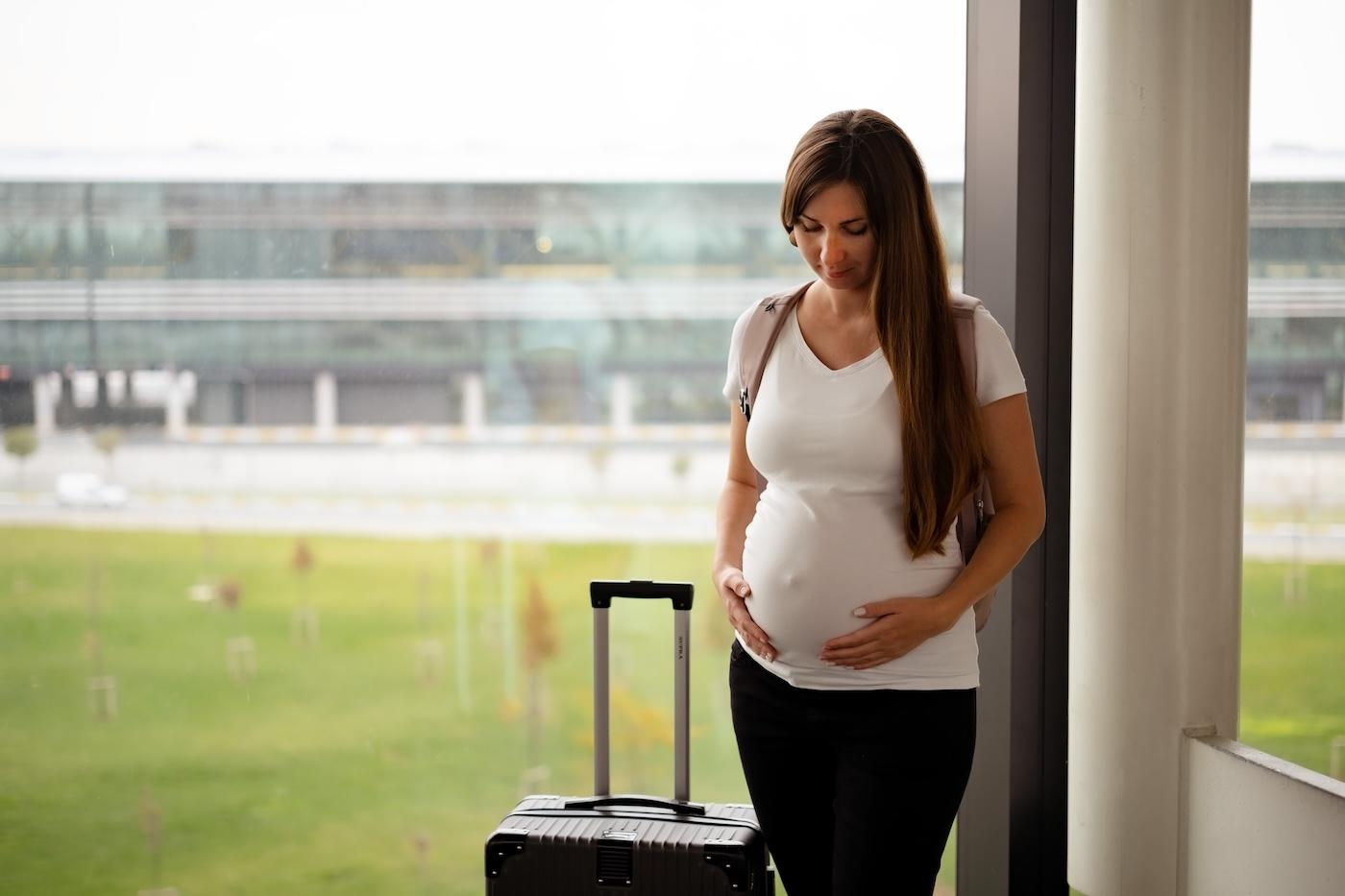
The short answer: Yes, for most people. If your pregnancy is uncomplicated, occasional air travel is considered safe. The second trimester is usually the most comfortable—and lowest-risk—time to fly. Most airlines let pregnant passengers fly until about 36 weeks, but policies vary, so check before you book. Once you're onboard, keep your seatbelt low under your bump, drink plenty of water, and get up and move to help prevent blood clots.
Maybe it's a babymoon you've been dreaming about since the second pink line. Maybe it's a work conference you can't skip, or a cross-country trip so the grandparents-to-be can finally meet the bump. Whatever's pulling you onto a plane, it's natural to wonder: Can I fly while pregnant? And if so, how late is too late?
For most pregnant people, the answer is a reassuring yes. Here's what the experts say about when to fly, when to stay grounded, and how to make your flight safer and more comfortable for you and your baby-to-be.
Is it safe to fly while pregnant?
For most people, yes! According to the American College of Obstetricians and Gynecologists (ACOG), occasional air travel is safe for pregnant people who don't have obstetric or medical complications, and they can fly following the same precautions as everyone else.
What about the cabin itself? Airplane cabins are pressurized to the equivalent of about 6,000 to 8,000 feet above sea level, and the Centers for Disease Control and Prevention (CDC) notes that the slightly lower oxygen level at that altitude likely won't cause problems for the baby in a normal pregnancy. Similarly, the Royal College of Obstetricians and Gynaecologists (RCOG) says there's no evidence that changes in air pressure or the dry cabin air harm you or your baby when your pregnancy is straightforward.
That said, "safe" comes with a few asterisks. The biggest considerations are your risk of blood clots, how far along you'll be when you fly (and when you fly home), and how close you'll be to good medical care if something unexpected comes up.
When is the best time to fly during pregnancy?
If your plans are flexible, aim for the second trimester. This is when the risk of common pregnancy emergencies is lowest. Complications are most likely in the first and third trimesters. Plus, by mid-pregnancy, many people find that the nausea and exhaustion of early pregnancy have lifted while late-pregnancy discomforts haven't quite kicked in.
Flying in the First Trimester
Flying early in pregnancy isn't off-limits, but it may not feel great. Some people prefer to stay put during the first trimester because of morning sickness and pregnancy fatigue, and motion sickness during a flight can make nausea worse.
You may also have heard that flying early on can lead to pregnancy loss, but there's no evidence that flying causes miscarriage. Sadly, miscarriage is common in the first three months of pregnancy—about one in five pregnancies—whether or not a person flies, which is why the timing can feel connected even when it isn't.
Flying in the Third Trimester
As your due date approaches, your chances of going into labor naturally rise. The safest time to fly is before 37 weeks if you're carrying one baby, and before 32 weeks if you're carrying uncomplicated twins. Late-pregnancy flights are also when airline rules and doctor's-note requirements come into play.
How many weeks pregnant can you fly?
It depends on your airline—and your pregnancy. Most commercial airlines allow pregnant passengers to fly until 36 weeks, but some restrict international travel earlier and some require documentation of how far along you are. Your healthcare provider may also advise against flying after 36 weeks.
A few things to keep in mind:
- Count the weeks for both legs of your trip. Consider how far along you'll be on your departure and return dates. A trip that starts at 34 weeks may end at 36!
- You may need a note. After 28 weeks, airlines may ask for a letter from your doctor or midwife confirming your due date and that your pregnancy is uncomplicated. Getting one can take time, so ask early.
- Expecting multiples? Plan to finish flying earlier. The RCOG recommends flying before 32 weeks with an uncomplicated twin pregnancy, and the NHS notes that labor is more likely from around 32 weeks with twins.
What are the risks of flying while pregnant?
For a healthy pregnancy, the risks of flying are low. But a few are worth understanding so you can plan around them.
Blood Clots (DVT)
Sitting still for hours can cause blood to pool in your legs, which can lead to a deep vein thrombosis (DVT)—a blood clot in a large vein. If part of the clot breaks off and travels to the lungs, it becomes a pulmonary embolism, which can be life-threatening. Pregnancy is one of the conditions that raises your chance of a clot, according to the CDC. In fact, the CDC notes that some experts estimate the risk of DVT is at least five times greater in pregnant people than in people who aren't pregnant—though the absolute risk is still low.
Your risk climbs with longer flights and with additional risk factors, such as a previous blood clot or being overweight. If you're taking a short flight (under four hours), you likely won't need any special measures.
Swelling, Stuffiness, and Queasiness
Even uneventful flights can come with some uncomfortable side effects. Pregnant flyers may experience leg swelling, a stuffy nose and ear discomfort (pregnancy congestion plus cabin pressure changes is a not-so-fun combo), and worsened nausea from motion sickness. Bloating can be an issue, too. Gases expand during flight, so it's smart to skip gassy foods and drinks—like broccoli and soda—before you board.
Turbulence
Because severe turbulence can't be predicted and could cause injury, ACOG recommends that pregnant people keep their seatbelts fastened the entire time they're seated—not just when the seatbelt sign is on.
Cosmic Radiation
Everyone who flies is exposed to a slight increase in radiation from space, but occasional flights aren't considered a risk to you or your baby, and ACOG considers the risk to the fetus negligible for most travelers. Pilots, flight attendants, and very frequent flyers may receive higher doses, so if you fly often for work, talk with your healthcare provider.
Being Far From Medical Care
Pregnancy emergencies are rare, but when they happen, they can come on suddenly. The CDC recommends that pregnant travelers—especially those in the third trimester—find medical facilities at their destination that can handle pregnancy complications, delivery, and newborn care before they leave. And if labor starts mid-flight, there's no guarantee anyone onboard will be trained to help with a birth, so the pilot may need to divert the plane.
Are airport security scanners safe during pregnancy?
Yes. You'll go through the same security screening as every other passenger, but this isn't considered a risk to you or your baby. Older walk-through metal detectors aren't harmful to a developing baby, and while today's body scanners emit low levels of radiation, most experts agree that the risk of complications from them is extremely low.
Who shouldn't fly during pregnancy?
Travel is rarely off-limits during a normal pregnancy. But if your pregnancy needs close monitoring, your provider may suggest postponing your trip. You may be advised not to fly—or to fly only with your provider's okay—if you have:
- Vaginal bleeding or a threatened miscarriage
- Signs of preterm labor or your water has broken
- Preeclampsia, either now or in a past pregnancy
- Placental problems, such as placenta previa or placental abruption
- Cervical insufficiency
- A suspected or confirmed ectopic pregnancy
- Fetal growth restriction
- Severe anemia, sickle cell disease, or a heart or lung condition that makes breathing difficult
- High blood pressure or diabetes that isn't well controlled
- Pregnant with multiples
How to Fly Safely While Pregnant
A little planning goes a long way toward a smooth, comfortable flight. Here's how to prep before you go—and what to do once you're in your seat.
Before You Book
- Talk to your healthcare provider. Share where you're going, how long your flight is, and when you'll be traveling. Flight length can affect your risks.
- Check your airline's pregnancy policy for both your outbound and return flights.
- Get travel insurance that covers pregnancy. Many health insurance plans don't cover pregnancy or newborn care outside the U.S., so it suggests looking into travel health insurance and medical evacuation coverage.
- Research your destination. The CDC advises pregnant people to avoid travel to areas with an active Zika Travel Health Notice, since Zika can cause serious birth defects. The CDC also recommends avoiding or delaying travel to areas with malaria, which can be much more severe during pregnancy.
- Pack your prenatal records. Bring a copy of your medical records and your provider's contact information, in case you need care while you're away.
On the Plane
- Buckle up below the bump. Wear your lap belt low across your upper thighs and under your belly—not over it. Ask the crew for a seatbelt extender if you need one.
- Choose an aisle seat. Sitting on the aisle allows you to more easily get up and move (bonus points for easier restroom access, as well!).
- Keep moving. Walk the aisle every hour. On flights longer than four hours, consider doing in-seat exercises every 30 minutes or so. Try these moves: Raise and lower your heels with your toes on the floor, raise and lower your toes with your heels on the floor, and tighten and release your leg muscles.
- Hydrate. Cabin air is very dry, so sip water regularly.
- Dress for comfort. Loose clothing and comfortable shoes make it easier to move around and won't restrict blood flow.
- Ask about compression stockings. The CDC recommends graduated compression stockings for pregnant flyers. Your provider can help you find the correct size and type, since medical-grade compression stockings are different from standard flight socks.
- Don't take aspirin "just for the flight." The CDC doesn't recommend aspirin to prevent travel-related blood clots, and low-dose aspirin doesn't appear to lower DVT risk. If your provider has prescribed low-dose aspirin for another reason, keep taking it as directed.
When to Call Your Healthcare Provider
Get medical care right away—before, during, or after your trip—if you notice any of these warning signs:
- Swelling, pain, redness, or warmth in your leg or arm (a possible blood clot)
- Trouble breathing, chest pain, or a racing heart (a possible clot in the lungs)
- Vaginal bleeding or leaking fluid
- Severe belly pain that won't go away or contractions
- Your baby's movements slowing or stopping
- A headache that won't go away, changes in your vision, or extreme swelling of your hands or face
- A fever of 100.4 degrees Fahrenheit or higher
- Dizziness or fainting
Flying While Pregnant FAQ
How late in pregnancy can I fly?
Most commercial airlines allow pregnant passengers to fly until 36 weeks, though some have earlier cutoffs—especially for international flights—and may ask for a note from your provider, per the CDC. If you're carrying twins, experts often recommend flying before 32 weeks. Always check your airline's specific policy.
Can I fly during my first trimester?
Yes, if your pregnancy is uncomplicated. There's no evidence that flying causes miscarriage. However, nausea and fatigue can make early-pregnancy flights uncomfortable, which is why many people prefer to travel in the second trimester.
Does flying cause miscarriage or early labor?
No. There's no evidence that flying causes miscarriage, early labor, or your water to break in a straightforward pregnancy.
Do I need a doctor's note to fly while pregnant?
Possibly. After 28 weeks, many airlines ask for a letter from your doctor or midwife confirming your due date and that your pregnancy is uncomplicated. Some airlines have their own forms, so contact your carrier ahead of time.
Is the radiation from flying harmful to my baby?
Not for occasional flyers. Occasional flights aren't considered a risk, and ACOG considers the risk from cosmic radiation negligible for most travelers. Airport body scanners are considered extremely low risk, too. If you fly frequently for work, talk with your healthcare provider.
Can I take motion sickness medicine on a plane?
Talk to your provider first. Antihistamines such as dimenhydrinate and meclizine are often used during pregnancy for motion sickness and morning sickness and appear to have a good safety record. Your provider can help you decide what's right for you.
What happens if I go into labor on a plane?
It's unlikely, but possible. Because there's no guarantee anyone onboard will be trained to help with a birth, the pilot may need to divert the flight. That's one reason experts recommend wrapping up air travel before late pregnancy!
More on Pregnancy Safety:
- Taking Baths While Pregnant: Is It Safe?
- Caffeine During Pregnancy
- Eating Fish During Pregnancy
- Exercise During Pregnancy—the Safest Ways to Sweat
***
REFERENCES- Air Travel During Pregnancy, Obstetrics & Gynecology, Aug 2018
- Centers for Disease Control and Prevention: CDC Yellow Book—Pregnant Travelers
- Royal College of Obstetricians and Gynaecologists: Air Travel and Pregnancy
- Mayo Clinic: Air Travel During Pregnancy: Is It Safe?
- National Health Service (NHS): Travelling in Pregnancy
- Centers for Disease Control and Prevention: Prevent Blood Clots
- Centers for Disease Control and Prevention: Zika Virus—Recommendations for Travelers and People Living Abroad
Disclaimer: The information on our site is NOT medical advice for any specific person or condition. It is only meant as general information. If you have any medical questions and concerns about your child or yourself, please contact your health provider.





SHARE THIS ARTICLE